How to Be Holy: The Process of Holiness


 Holiness is a process, which means that it takes time and continual effort.  It doesn’t happen all at once.  It is a process of transformation by renewal (Rom. 12:2).  Renewal starts with the mind and then works into the character.  The objective of renewal is always to renew the whole person: spirit, mind and body (complete renewal, however, will come after this life on earth; read 1 Cor. 15:51).

 Have you ever seen an old building being renovated?  All the old rotten material is removed and new material is put in its place.  Sometimes it is found that the entire building must come down and be replaced.  And so it would be a process of starting over.  That is the picture of what renewal is.  It is a renovation process.  The old comes out and the new is put in its place.  Hence, with us, all uncleanness and all sinful thoughts and behaviors must be removed; then new thoughts and behaviors will take their place.

This work of renewal is a work of the Holy Spirit (Titus 3:5), not something we can do on our own.  He is the carpenter and we are as tools in his hands.  Therefore, as He works on us to build us up, we as His hammer and saw must willingly give ourselves to Him so that His work on us will be complete and unhindered.  Thus He does the actual work of renewal and we work to support His work.  Our work is the work of consecration and prayer, the work of service and obedience.  Such is the process of renewal that brings us to holiness.  Here are three things we must work at to be holy:

1.  We pray.  First of all, we must pray.  Let us pray with understanding and with persistence and faith.  As to understanding, when we pray for holiness, I believe it would be especially beneficial to understand how our sinful desires come against us; that is, to understand our weakness and how Satan takes advantage of us.  Thus we should look back to consider how he has tempted us and what desires he has appealed to—so that we can pray more intelligently.

Then, in all our praying, let us pray with persistence and faith, understanding that prayer is part of the hard work of holiness, which takes time and effort.

2.  We work at renewing ourselves.  Another part of the work we do, besides prayer, is we actually participate in His work of renovation.  As I can see from Paul’s writing (in Colossians 3), we do two basic things: (1) We work to put to death and to take off the things of the earthly nature (referring to the sins of the body) and of the old self (referring to the sins of the spirit and the mind); and (2) we work to put on a new self (referring to the character and behavior) and a new mind and spirit (referring to the thinking process).

Now when you renovate a building you always tear out the old material first, and then put in the new.  But for human renovation, we do both things at once.  We take out the old and put in the new at the same time. 

The way we take out the old stuff of our earthly nature—fornication, uncleanness, covetousness, etc. (Col. 3:5)—is to put it to death, or destroy it.  And the way we do that is to starve those evil desires in us, so that they are deprived of their power and die.  But how do we do that?  Well it’s really quite easy; we just reduce our exposure to those sins.  For example, if you have a problem with sexual lust you just stop going to movies and watching TV shows, and looking at magazines, etc., that have a sexual content to them.  And if you have a problem with fornication you will also stop doing those things that I have just mentioned, but you will also stop dating or even talking to those you know you will be tempted with.  Hence, by reduced exposure to sin, those sinful desires will die. 

In addition to putting to death our earthly desires, we must also put off the deeds of the old self, such as anger, wrath, and malice, etc. (Col. 3:8).  These, as I mentioned earlier, are the sins of the spirit and the mind.  But how do we get rid of these things?  Well, here is where it helps to put in the good stuff at the same time, because when we set our mind on things above, that is, to meditate on Gods Word and His love to us etc., He gives us the power to quit those bad things and to put good things in their place, such as tender mercies, kindness, and humility (Col. 3:12).  These are the things of the new self, which every Christian has within him.  This new self is the very nature of Christ who dwells in you.

3.  We work to form holy habits.  The work we do in this process of holiness (the process of renewal) cannot be done without the discipline of habits.  That is, His work of holiness in us will not be complete and effective, unless our work is done right, as we learn how to stop bad habits and form good habits. 

But why are habits important?  Can’t we just pray for God to help us be holy, and then won’t He help us do those things that we should do?  Doesn’t the forming of habits suggest that we are doing it in our own power without His help?

No, not at all!  In fact, it is natural and created in us that when we do something over and over again, a habit will develop.  Romans six tells us that when we present ourselves as slaves to obey something, either to obey sin or to obey righteousness, we become a slave to that thing.  That is what a habit really is—becoming a slave to something.  And Paul tells us that when we become a slave of sin (when we have sinful habits) those things lead to spiritual death (Rom. 6:16, 23).  But when we become a slave of righteousness (when we have good habits) those things lead to holiness (Rom. 6:22).  So good habits are good!  It is good to build habits of righteousness.

But how do we develop these good and holy habits?  And how do we stop the bad habits?  Well, both can be gained the same way: first, by prayer and commitment, second by determined repetition.  In regard to bad habits, we must pray and plan to quit them, and then to continually say no to them.  Likewise, in regard to good habits, we must pray and plan to do them, and then continually say yes to them.  The thing about habits that is encouraging is this: the more we reduce a sinful habit the less power it has over us, and the more power we have to discontinue it; and the more we are able to increase a good habit the more power we have to continue to do that good thing.

The power of a habit is real!  And it works!  But it will only work if you are committed to making it work and will trust God in prayer to help you make it work.  Yes, if you believe God in prayer that He will help you discontinue or continue a habit, and if you are determined yourself to do it, He will help you, and you will do it.  Isaiah 50:7 says, “Because the Lord God helps me, I will not be dismayed; therefore, I have set my face like flint to do his will, and I know that I will triumph” (TLB).

Posted in Holiness and Prayer, Prayer A to Z Excerpts | Tagged , , , , , , , , | 1 Comment

God Has Gifted Every Christian for Holiness


 Since it is God’s will for every Christian to be holy, He has given us the following gifts as necessary resources for holiness.


Jesus Christ


 When you were saved you received Jesus as a gift (Jn. 1:12).  In Him you were justified and made righteous—absolutely holy.  “For He [God] made Him [Christ] who knew not sin to be sin for us, that we might become the righteousness of God in Him” (2 Cor. 5:21).  Hence, His righteousness is credited to us.  That means that positionally, we are eternally righteous and holy before God; we were made holy forever in Christ.

 Now, though we are holy and sinless in our position or standing before God, practically we are not sinless and holy.  In fact, though we have a new nature and desire not to sin, we still have our old sinful flesh; and so we find that we sin more than we really want to (Read Romans 7).

But Jesus is a gift for us in that area too.  For when He came into us He came in to reign in us and to give us the power to be holy.  Thus, when we received Christ as Lord, He, in fact, came into us and united us with Him, so that, in His resurrection we were raised up with Him in His new life and power.  Hence, what this means is that we are now dead to the reign and rule of sin; it has no power over us to make us obey its wishes.  It means also that we have a new power in Christ—we have the power to obey God and to be holy as we really want to be, or as He wants us to be (Read Romans 6).


The Holy Spirit


The Holy Spirit is that gift to us that does the work of holiness.  From the start He is the one that leads us to God and works in us to desire His will and holiness (Phil. 2:13).  He helps us to see how holy God is and how sinful we are.  He works in us the spirit of repentance and surrender.  Then, as we repent of our sins and submit to God’s will, He works in us mightily to cleanse our heart from sin, making it a fit dwelling for Christ (Eph. 3:16-17).

Also, as we continually submit to the Spirit’s control and follow His leading, He will give us the power to resist gratifying the desires of the sinful nature; therefore, we will not do the works of the flesh, such as these: “adultery, fornication, uncleanness, lewdness, idolatry, sorcery, hatred, contentions, jealousy, outbursts of wrath, selfish ambition, dissentions, heresies, envy, murders, drunkenness, revelries, and the like” (Gal. 5:19-21).

Instead, when we follow after the Spirit, He will produce in us the good fruit of His Spirit, which are these: love, joy, peace, longsuffering, kindness, goodness, faithfulness, gentleness, and self-control” (Gal. 5:22-23).


The Bible


The Bible, which is the Word of God, is a most valuable gift from God for our holiness.  From it God speaks to us.  For it is “living and powerful;” and it is like a “two-edged sword” that pierces into our soul and spirit and body.  Through this living Word, God discerns our thoughts and intentions and exposes our sins (Heb. 4:12). 

 But He never leaves us bleeding.  For the Word also is a healer of the heart, and it cleanses us from sin (Ps. 119:9). 

 When we meditate on it, and hide it in our heart to obey it, it causes us to delight in Him (Ps. 40:8), and it keeps us from sin against Him (Ps. 119:11).

 The Word also trains us in holiness (or righteousness).  How does it train us?  Well, God’s part is to instruct us and teach us by His Word and through His Spirit; and He also reproves and corrects us along the way (2 Tim. 3:16).  My part in the training is to consistently obey Him, pray, and learn what He is teaching me.  The key to training is to learn what God is teaching me; and the process is by the discipline of developing godly habits.  We may fail along the way, but that is part of the process of learning.  Jerry Bridges has said, “The person who is disciplining himself toward holiness fails many times but he doesn’t quit.  After each failure he gets up and continues the struggle.”  


The Conscience


The conscience is a God-given inner sense of right and wrong.  It is that inner part of us that judges our actions, words, thoughts, and motives, and then gives witness to that judgment.  It will either accuse us or defend us. 

Our conscience (that inner sense) was created in us by God (Rom. 2:15).  And if it wasn’t affected by sin, it would be perfectly good, and one hundred per cent reliable.  But every conscience is conditioned and developed by our teaching and culture.  Thus, each of our consciences is different.  Generally speaking, a good conscience has been conditioned by God’s Word and truth, and a bad conscience (a defiled and seared conscience) is one that has been misguided or callused by sin to the point where it does not know right and wrong (1 Cor. 8:7, Eph. 4:18, 19).

How does God’s gift of conscience (a good conscience—not yet defiled) help us to be holy?  There are generally three points at which the conscience helps us to overcome temptation to sin:

1. Before a sinful action is started, when temptation begins, the conscience warns us that trouble is ahead.  It puts up a warning sign in front of us in our mind that says, “Warning!  What you are about to do is wrong!”

2. When sin has begun, the conscience is quieter, but it still warns us not to go further.

3. When sin is finished, that is when the conscience is the loudest and the most accusing.  It tells us that we have really blown it!  Hence, it moves us to repent.

The conscience also witnesses to us when we have not sinned.  This is when the conscience is “clear” (Acts 24:16, Rom. 9:11, 2 Cor. 1:12).  In this case the conscience is a great encouragement to us and keeps us going strong in the right direction.  It puts up a sign in our mind that says to us, “Way to go!”

 So the conscience is a great gift of God to us—to either warn us of sin, urge us to repent, or to encourage us for good behavior.


Prayer


Even though your character is not what it should be, if you desire to be holy, and sincerely pray for it, God will definitely hear and answer that prayer.  Why?  Because it is a prayer of right motives (Ja. 4:3), and according to the will of God.  E. M. Bounds has said, “The more we pray the better we are, the purer and better our lives…Prayer produces cleanness of heart and purity of life…It creates a distaste for sinning, and so works upon the heart.”

Prayer is necessary and fundamental at every point of your pursuit for holiness.  Hence, in everything you do, if you want to remain pure, you must continue in prayer.

Posted in Holiness and Prayer, Prayer A to Z Excerpts | Tagged , , , , , , , , | 1 Comment

Six Reasons to Be Holy

Not everyone desires holiness. But just in case you do, just in case God has put it on your heart to be like Him, I think you will find these point helpful. Here are six reasons to be holy.

1.  To be like God.  God created man and woman in His own image, according to His likeness (Gen. 1:26).  This of course included His holiness.  God wanted all mankind to be holy like Himself.

After the fall of man sin marred that image.   But God’s purpose for us did not change.  He has always wanted us to be holy like Him, even in a sinful world (Gen. 2:14, 15).  In fact, throughout the Old Testament He commanded His people to be holy, saying to them, “Be holy because I, The Lord Your God, am holy” (Lev. 19:2, NIV).

And we can be holy!  God has provided a way for us to be holy through the redemption of His Son Jesus. For in His redemption God has predestined us and called us (those He has elected to be saved) to be conformed to the image of His Son (Rom. 8:28, 29).  “He chose us in Him before the foundation of the world, that we should be holy…” (Eph. 1:4).  Why?  Because He wants us to be like Himself and like His Son Jesus, “that we may share in His holiness” (Heb. 12:10).

 2.  To please God.  If God has called us to be holy, it stands to reason that our holiness will please Him.  And the scriptures back it up.  Proverbs 15:26 says, “The Lord detests the thoughts of the wicked, but those of the pure are pleasing to him” (NIV).  Again in Prov. 11:20 it says, “The Lord detests men of perverse heart but he delights in those whose ways are blameless” (NIV).

 3.  To gain the friendship of God.  In Psalms 15:1 when David asked God the question, “Who may dwell in Your holy hill?” I think he was really asking Him who was qualified to be His friend and to abide in His presence.  The answer of course (to sum up the rest of the chapter) is “he that is holy”—he that has committed himself to living a sinless life.

Oh, to be a friend of God and to dwell in His presence; that has to be one of the greatest motivations for holiness.   For to be in His presence is shear joy and pleasure (Ps. 16:11).  It is not a pleasure anything like this world has to offer.   It is a holy pleasure, free of guilt.  It is the pleasure of knowing Him, of being near Him, and of seeing Him just as He is—in all His love and power and purity.

 4.  To have an effective prayer life.  This forth reason to be holy may seem to be a rather selfish reason, but it really isn’t.  For prayers are for His purposes and work.  Thus, He wants us to be holy so that through our prayers His work will be accomplished.  For He will not trust His work to the unholy.  When they pray to Him He won’t even listen.  John 9:31 says, “We know that God does not listen to sinners.  He listens to the godly man who does His will.”  For the godly (the holy) see things from God’s perspective and they pray according to what is on His heart.  Therefore, according to James 5:16, “The effective, fervent prayer of a righteous man avails much” (Ja. 5:16).

 5.  To be a good example to the world.  Paul wrote to the Philippian church that they were not to complain or argue with each other, so that they would become blameless and harmless, and so that they would shine as lights in the world (Phil. 2:14-15).  Our holiness surely does affect our light.  The holier we are the brighter our light will shine.  Let us always be careful not to complain or argue, but rather to rejoice and give thanks—so that others around us may see our good and holy lives, and therefore, that they may give glory to God and even come to know Him.

 6.  To experience His promises.  God has promised wonderful things to the holy.  Here are just three of His promises: (1) He has promised to provide for them.  In Psalms 84:11 He says, “…no good thing does he withhold from those whose walk is blameless.”  (2) He has promised to protect them.  In Proverbs 2:7-8 it says, “…He is a shield to those whose walk is blameless, for he guards the cause of the just and protects the way of his faithful ones” (NIV).  (3) He will bless them. In Psalms 1:1-3, David says, “Blessed is the man who does not walk in the counsel of the wicked or stand in the way of sinners or sit in the seat of mockers.  But his delight is in the law of the Lord, and on his law he meditates day and night.  He is like a tree planted by streams of water, which yields its fruit in season and whose leaf does not wither.  Whatever he does prospers” (NIV).

Posted in Holiness and Prayer, Prayer A to Z Excerpts | Tagged , , , , , , , , | 1 Comment

The Meaning of Holiness

I think we have a good definition of holiness in Psalms 15:1-2.  Here David asks, “Lord, who may dwell in Your sanctuary?  Who may live on Your holy hill?  Then he answers himself: “He whose walk is blameless and who does what is righteous” (NIV).  Hence holiness is two things: being blameless, or not doing what is wrong; and it is also doing what is right. 

We have this same definition in Job 1:1. Here we read, “In the land of Uz there lived a man whose name was Job.  This man was blameless and upright; “he feared God and shunned evil” (NIV).  Thus, those who are holy fear God—have a reverent respect for God and seek to obey Him in everything.  They also endeavor to conform to His holy character, which would include shunning or hating sin

In the simplest terms, holiness is living “without sin.”  That is what Jerry Bridges has suggested in his book The Practice of Godliness.  He states, “The best practical definition [of holiness] that I have heard is simply ‘without sin’.  That is the statement that was made of the Lord Jesus’ life on earth (Heb. 4:15), and that should be the goal of every person who desires to be godly.”


A Look at God’s Holiness


If you want to be holy and to know exactly what it looks like, there is only one person who will give you a perfect picture of it—God Himself.  As we have discussed, to be holy is to be without sin.  And that is how we should view God—with absolutely no sin.  He is free of evil.  He is pure as light.  1 John 1:5 says, “God is light and in Him is no darkness at all” (Read also John 1:4-9).  Hence, if darkness represents sin, and light represents no sin, this is the perfect illustration.  For even though light shines in the darkness, the light at no time will become dimmed by the darkness; yet light always penetrates darkness and makes it less dark.  So it is with God.  He is forever without sin, yet He goes into the dark sinful world, shinning His holy light (Jn. 1:5).  His light always penetrates darkness yet darkness never dims His light. 

God’s holiness has also been described in the Bible as an adornment of beauty and splendor, of majesty and glory.  In 1 Chronicles 16:29 (in the NKJV) it says, “Oh, worship the LORD in the beauty of holiness.”  In the NIV it says “…in the splendor of holiness,” and in the NAS it is translated “…in holy array.”  Putting it all together, I conclude that His holiness is as a beautiful adornment, shinning with splendor. 

But His holiness does not stand alone, isolated from the rest of His attributes.  His holiness adorns all of His character qualities and makes them all shine.  Arthur W. Pink suggests that His holiness is a transcendental attribute, that it runs through all the rest of His attributes and casts a holy luster on them.  Stephen Charmock writes: “[His holiness] is the glory of every perfection in the Godhead; as His power is the strength of them, so His holiness is the beauty of them; as all would be weak without almightiness to back them, so all would be uncomely without holiness to adorn them.”

Now there is one more thing about God’s holiness that we have to talk about.  It is the fact that holiness is not only opposite of sin, it hates sin; it is the enemy of sin, and it must punish sin.  If we don’t have this attitude about sin our holiness isn’t really very holy.  Thus if you want to be more holy you must hate sin and be its enemy.  Yes, hate it more and more and you will be more and more holy.

Stephen Charmock has written well on how God has demonstrated His holy hatred of sin at the cross.  He says, 

 Not all the vials of judgment that have or shall be poured out upon the wicked world, nor the irreversible sentence pronounced against the rebellious demons, nor the groans of the damned creatures, give such a demonstration of God’s hatred of sin, as the wrath of God let loose upon His Son.  Never did divine holiness appear more beautiful and lonely than at the time our Savior’s countenance was most marred in the midst of His dying groans.


Yes, holiness is most beautiful when sin is hated and punished.  And how must God hate sin to offer His own son—that He would in fact pay for sin’s penalty with His own blood.  Let us have that same attitude of God, to hate sin and to be its enemy, thus to do everything we can in Christ to destroy it.  Then and only then will holiness reign in beauty.


Posted in Holiness and Prayer, Prayer A to Z Excerpts | Tagged , , | 2 Comments

Tornadoes: Is not God in Control of the Weather? Part 2


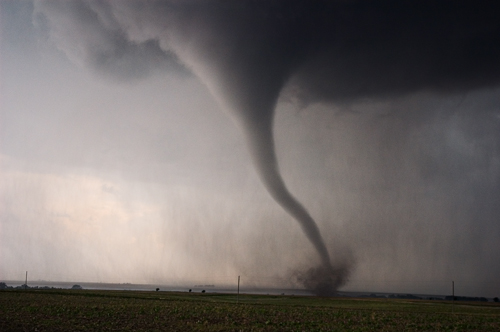
In an earlier writing of this topic (part 1), I did a brief review of the May 29th front page tornado article in the Minneapolis Star Tribune entitled “Tornado Assault Baffles Science.”  It was of course an article covering the recent deadly tornadoes, especially of May 22—in North Minneapolis and Joplin Missouri.  The focus of the article was about how tornadoes have suddenly gotten more deadly and more frequent, and about how scientists have been baffled at the mysterious recent weather patterns, such as the jet stream blowing so fast and so far south at this early in the season.  I sited Paul Douglas as saying “Curious things are going on in the atmosphere,” curious things, he said, that were “very odd.” 

I want to return now to what I was saying in response to that article.  Instead of trying to understand things totally through science I suggested, and I still hold, that God has everything to do with what’s been happening: that He is in charge of the weather; that He controls the weather.  I have had some time now to study this, and I would like to present it to you in three points: (1) God controls the weather; (2) He uses deadly storms for His purposes and for our good; and (3) our response.


God Controls the Weather


God has always controlled everything.  He holds everything together.  As for the chaotic weather we’ve been having, the “curious things going on in the atmosphere,” He knows about that too.  In fact, He created it; He caused it for our good.  Does that sound odd for me to say that?  Well, let me explain.  When man sinned in the garden, God said to Adam, “Cursed is the ground for your sake.”  In Romans 8:19-22 Paul explains that the curse was not just in that garden or just on the ground; it was over the entire universe.  It was a curse that has affected all of nature, including the weather.  The condemnation of mankind has been imprinted on the heavens, and on the earth, and on all creation.  It’s almost as if the whole universe is suffering for our sins.  All of nature is under the bondage of corruption because of us.  But there is also another way to look at it.  One commentator has suggested—and I agree with him—that God cursed the earth, and the whole universe, to mature us and to help perfect our character—the kind of character that is needed to be in God’s family.  This idea is confirmed for us in Romans 5:3-4 and James 1:2-4.  Therefore, God gave us a cursed universe not to punish us, but rather to keep us working at making things better, and to keep us humble, and to keep us praying and seeking Him, hence, to make us holy.

 Therefore, God brought about the curse on the earth and on the weather for our good.  And He continues every day to control and direct the weather, and all of nature.  He didn’t just curse the universe and leave it alone.  He is watching over it and controlling it.  He uses Satan to move it; He uses the natural corruption process (but, I’m not sure how that works); and I’m sure He intervenes and moves the weather Himself and by His angels whenever He desires.  Scripture backs this up.

I have always been intrigued at how God used Satan to test Job: to cause fire to fall from heaven and to move the wind, causing destruction and death.  Let’s look at this passage.

 Job 1:12-19

Then the Lord said to Satan, “Behold, all that he has is in your power, only do not put forth your hand on him.” So Satan departed from the presence of the Lord.

13 Now it happened on the day when his sons and his daughters were eating and drinking wine in their oldest brother’s house, 14 that a messenger came to Job and said, “The oxen were plowing and the donkeys feeding beside them, 15 and the Sabeans attacked and took them. They also slew the servants with the edge of the sword, and I alone have escaped to tell you.” 16 While he was still speaking, another also came and said, “The fire of God fell from heaven and burned up the sheep and the servants and consumed them, and I alone have escaped to tell you.” 17 While he was still speaking, another also came and said, “The Chaldeans formed three bands and made a raid on the camels and took them and slew the servants with the edge of the sword; and I alone have escaped to tell you.” 18 While he was still speaking, another also came and said, “Your sons and your daughters were eating and drinking wine in their oldest brother’s house, 19 and behold, a great wind came from across the wilderness and struck the four corners of the house, and it fell on the young people and they died; and I alone have escaped to tell you.”

NASB

 In all this, Job did not credit his calamity to Satan, but rather to God, saying

Job 1:21

“Naked I came from my mother’s womb,

And naked I shall return there.

The Lord gave and the Lord has taken away.

Blessed be the name of the Lord.”

NASB


Job knew that though Satan indirectly buffeted him; God was the prime mover and was in control.  Yes, God controls all things.  He is on the throne of the universe, directing all things, working all things “after the counsel of His own will” (Eph. 1:11).  Here are a few passages that will point this out; they are particularly how God controls the wind.


Ex 10:13-15

13 So Moses stretched out his rod over the land of Egypt, and the Lord brought an east wind on the land all that day and all that night. When it was morning, the east wind brought the locusts. 14 And the locusts went up over all the land of Egypt and rested on all the territory of Egypt. They were very severe; previously there had been no such locusts as they, nor shall there be such after them.

NKJV


Ex 10:16-20

16 Then Pharaoh called for Moses and Aaron in haste, and said, “I have sinned against the Lord your God and against you. 17 Now therefore, please forgive my sin only this once, and entreat the Lord your God, that He may take away from me this death only.” 18 So he went out from Pharaoh and entreated the Lord. 19 And the Lord turned a very strong west wind, which took the locusts away and blew them into the Red Sea. There remained not one locust in all the territory of Egypt.

NKJV


Ex 14:21-22

21 Then Moses stretched out his hand over the sea; and the Lord caused the sea to go back by a strong east wind all that night, and made the sea into dry land, and the waters were divided.

NKJV


Num 11:31

31 Now a wind went out from the Lord, and it brought quail from the sea

NKJV


Ps 107:25

25 For He spoke and raised up a stormy wind,

Which lifted up the waves of the sea.

NASB


Ps 135:7

7 He causes the vapors to ascend from the ends of the earth;

Who makes lightnings for the rain;

Who brings forth the wind from His treasuries.

NASB


Ps 147:18

He causes His wind to blow and the waters to flow.

NASB


Jer 51:16

16 When He utters His voice, there is a tumult of waters in the heavens,

And He causes the clouds to ascend from the end of the earth;

He makes lightning for the rain,

And brings forth the wind from His storehouses.

NASB


Ezek 13:13

13 “‘Therefore this is what the Sovereign Lord says: In my wrath I will unleash a violent wind, and in my anger hailstones and torrents of rain will fall with destructive fury.

NIV


Jonah 1:4

4 Then the Lord sent a great wind on the sea, and such a violent storm arose that the ship threatened to break up.

NIV


Jonah 4:7-8

But at dawn the next day God provided a worm, which chewed the vine so that it withered. 8 When the sun rose, God provided a scorching east wind, and the sun blazed on Jonah’s head so that he grew faint.

NIV


Mark 4:39-41

39 He got up, rebuked the wind and said to the waves, “Quiet! Be still!” Then the wind died down and it was completely calm.

 40 He said to his disciples, “Why are you so afraid? Do you still have no faith?”

 41 They were terrified and asked each other, “Who is this? Even the wind and the waves obey him!”

NIV


Zech 10:1

Ask the Lord for rain in the springtime;

it is the Lord who makes the storm clouds.

NIV


Four ways God Uses Tornadoes and Natural Disasters for Our Good


1.  To Warn Us.  If God is in control of the weather and the tornadoes (as He is), the question will always come up: why does He choose to destroy some homes and kill some and others not?  What have some done to deserve judgment and why did the rest escape?  Jesus proposed a similar question to a group of people as they encountered two different tragedies.

 Luke 13:1-5

There were present at that season some who told Him about the Galileans whose blood Pilate had mingled with their sacrifices. 2 And Jesus answered and said to them, “Do you suppose that these Galileans were worse sinners than all other Galileans, because they suffered such things?  3 I tell you, no; but unless you repent you will all likewise perish.  4 Or those eighteen on whom the tower in Siloam fell and killed them, do you think that they were worse sinners than all other men who dwelt in Jerusalem?  5 I tell you, no; but unless you repent you will all likewise perish.”

NKJV

 In these two incidents Jesus pointed out that just because some perished it does not mean that they were worse sinners then anyone else.  But he made a point of teaching that unless they repent they will perish too.  This suggests to us that there is a connection between a catastrophe of this sort and sin—that God may use it to punish sin.  The teaching here seems to be that since God does use sudden disasters to punish sin we would do well to take it as a warning if we are unrepentant.

I am not saying that all those who suffered hardship or died in the recent tornado assault were being punished by God for some sin.  We don’t know that.  But it is possible. And we who witnessed the tornado ought to take it as a warning, that unless we repent of sins we may be engaged in, the same thing could happen to us.

 God not only uses natural disasters to judge and warn individuals, He also uses them to warn and judge whole nations for wrong actions against other nations.  There is ample evidence that this has been happening with the United States.  God has been judging the U. S. by hurricanes, tornadoes and floods because of our actions toward Israel; our government has been trying to convince Israel to divide their land and give up part of their land.  God tells us in Zech. 12: 9, “It shall be in that day that I will seek to destroy all the nations that come against Jerusalem.”  God is very protective of His people; He will not back down on His promise to protect them. 

 Bill Koenig in his book Eye to Eye has documented several occurrences of natural disasters correlating with our pressuring Israel.  The following is an advertisement for his book, which I found on this website:

What do these major record-setting events have in common?

  • Nine of the ten costliest insurance events in U.S. history
  • Six of the seven costliest hurricanes in U.S. history
  • Three of the four largest tornado outbreaks in U.S. history
  • Nine of the top ten natural disasters in U.S. history ranked by FEMA relief costs
  • The two largest terrorism events in U.S. history

All of these major catastrophes transpired on the very same day or within 24-hours of U.S. presidents Bush, Clinton and Bush applying pressure on Israel to trade her land for promises of “peace and security,” sponsoring major “land for peace” meetings, making major public statements pertaining to Israel’s covenant land and/or calling for a Palestinian state.

Are each one of these major record-setting events just a coincidence or awe-inspiring signs that God is actively involved in the affairs of Israel?

In this book, Bill Koenig provides undeniable facts and conclusive evidence showing that indeed the leaders of the United States and the world are on a collision course with God over Israel’s covenant land.

Just recently, on May 19th our government announced that Israel must go back to the 1967 borders.  Well, we know what happened just after that announcement. Tornadoes bombarded the U. S.  On May 22 Joplin was leveled and over 130 people died.


2.  As a Sign of Jesus’ Coming.  Tornadoes have not been listed as one of the signs of His coming; however, all natural disasters have been getting more frequent and more deadly, just as earthquakes have.  And earthquakes are listed as a sign of his coming.  So I really think that tornadoes and all natural disasters can go under the same category as earthquakes, particularly because these things are getting more frequent and more deadly—just like a woman’s labor pains.  This phenomenon is the sign of His coming, and we really should take notice of it—to ready ourselves and to warn others.


3.  To Mature Us.  Every trial we face will work to mature us if we believe it and have a joyful attitude toward those trials (Ja. 1:2-4).  Destruction and suffering caused by tornadoes is no exception.


4.  As an opportunity to serve.  As we trust God to comfort us in trials—and He will—we will be in good position to comfort others (2 Cor. 1:3-5).  And if we have not been touched by trials, but are around those who are, we should count it as an opportunity for us to reach out and aid those who suffer.


Our Response


We can complain, blame, or cower in fear when tornadoes come.  But if we realize that God is in control of all things and that He in fact is right there in the storm directing it, moving it, that is comforting to me.  Why?  Because God is good and righteous.  And I would rather have a good and righteous God control the weather than a cruel devil or demons or Mother Nature (Who is Mother Nature anyway?  How can nature control anything?  That’s like saying that the wind has a mind and does what it wants).

 If you don’t believe God and you live in sin, you have a very good reason to fear tornadoes.  But if you repent of your sin and turn to God, He will comfort you and take your fear away—because God is a God of love.

 When I hear of a tornado coming I always get excited and I feel God’s presence.  Tornadoes to me are a display of His great and awesome power. I like to look up in the sky and imagine that God is up there demonstrating His power—that He is powerfully and majestically directing the wind (which He is).  I love Psalms 104:3:

 You lay out the rafters of your home in the rain clouds.

You make the clouds your chariots;

You ride upon the wings of the wind.

NLT

And we must not forget to pray.  Even if we aren’t afraid of the storms, there are many who are.  Prayer for prayer warriors can be a great testimony for those who don’t believe.  Do you believe God can move the direction of a tornado if we pray?  I do.  Just as Moses prayed to the Lord to remove the locust from Egypt and the Lord caused a strong west wind to blow the locus into the sea (Ex. 10:16-19), God is able to move a tornado out of our way.

 Yes, God is in control of the weather!

 

Posted in Bible Studies, Understanding the Times | Tagged , , , , , , , , | 3 Comments

God’s Ten Purposes for Prayer


This is an excerpt from my book Purpose of Prayer.  You can get it as an e-book at my website.

1.  Prayer is God’s idea as the way to acquire salvation.  Whether it is verbal prayer or a silent prayer of the heart, God has designed that salvation will come to us when we cry out to Him in prayer.  For He has said in His Word, “Whoever will call upon the name of the Lord will be saved” (Rom. 10:13).  Hence, God has made prayer a tool that gives expression to our faith and works it out.  Therefore, our prayer of faith acquires salvation—as we ask Jesus into our heart and He comes in and redeems us from our sins.         

2.  Prayer is God’s idea as the means for His will to be carried out in accordance with His great plan.  God has planned from eternity past that through prayer we would share His vision and His rule.  That is, by prayer we realize His vision and rule and that we are called to share in it; and then we actually share His vision and rule through our prayers.  Wesley Duewel writes,

He has made us to be priests to God, which certainly includes the intercessory role of all priests (Rev. 1:6).  We are to be not only holy priests (1 Pet. 2:5), however, but royal priests (v. 9), appointed to serve our King.  In the light of other Scriptures, this responsibility obviously includes our being given a kingly rule in our intercession.  We become interceding royalty.  We, like Jesus, rule and extend Christ’s rule by our prevailing intercession.

3.  Prayer is God’s idea as a means to resist Satan.  We can’t destroy Satan by our prayer, but we can by prayer prevent Him from destroying us.  We can pray out the evil that Satan brings, and pray in healing and truth.  We do it in connection with God’s Word of truth.  Hence, when we prayerfully repent of our sins and pray the truth of scripture into us, the strongholds of Satan (made up of lies) will be destroyed.  Therefore, by the mighty weapon of prayer, according to the Word of God, we are able to resist Satan and bring every thought into captivity to the obedience of Christ (2 Cor. 10:4-5). 

4.  Prayer is God’s idea as a way to bring help in trouble.  For many of us trouble is when we have car problems, when the baby is sick, or when we can’t pay the bills.  To others trouble is not having a home; or it is being in prison.  Trouble always seems so terrible; it brings with it so much fear and pain.     

What do we do?  Well, God has designed prayer to bring us help in trouble.  I have found that in most of the passages of the Bible, when people were in trouble and prayers were made, prayer was for deliverance out of trouble.  Psalms 50:15 says, “Call upon Me in the day of trouble; I will deliver you, and you shall glorify Me.”  We can also read from Psalms 81:7, and Psalms 107:6, 13, how God promises to deliver when prayers are made.  These verses, and many more, speak of how God delivers people out of trouble when they pray. 

But in God’s deliverance trouble is not always removed.  Deliverance sometimes is the help He gives us through prayer to go through trouble; then He will use that trouble to strengthen us and comfort us and to give us patience (Read Ps. 119: 143, Nah. 1:7, and 2 Cor. 1:4).            

5.  Prayer is God’s idea as the way to receive the power of the Holy Spirit.  If you have received the Holy Spirit by asking for Him in prayer (Lu. 11:13), it makes sense that He will also give you His power by asking?  Ask for His power and you will receive it!           

And the very first thing you will notice when you ask is that you will be enabled in your prayer weakness to see things from God’s perspective.  According to Duewel, “[the Holy Spirit enables us as we pray] to see people and needs from His perspective.”

Accordingly, that power is the power for soul winning.  Many Christians, including you, may not even know about this power.  But if you would set your mind to witness, and prayer for the Holy Spirit’s power (Acts 1:8) you will see great things happen.  For instance, if you would prayer for boldness as they did in Acts 4:29, I believe boldness would be given to you just as it was given to them.  For verse 31 says, “And when they had prayed, the place where they were assembled together was shaken; and they were filled with the Holy Spirit, and they spoke the Word of God with boldness.”          

6.  Prayer is God’s idea as the way to get our daily bread.  When Jesus told His disciples to pray “Give us this day our daily bread” (Matt. 6:11), He was revealing to them the great idea of God—that they could ask for what they needed each day and receive it.  Hence He was also giving them the idea that God is our Father and that He loves us and wants to give us all the things we need.  He expressed this idea to them in Matthew 7:7-11.  He said to them, “Ask, and it will be given to you; seek, and you will find; knock, and it will be opened to you.  For everyone who asks receives, and he who seeks finds, and to him who knocks it will be opened.  Or what man is there among you who, if his son asks for bread, will give him a stone?  Or if he asks for a fish, will he give him a serpent?  If you then, being evil, know how to give good gifts to your children, how much more will your Father who is in heaven give good things to those who ask Him!”

7.  Prayer is God’s idea as the way to receive guidance.  Psalms 119:105 says, “Thy Word is a lamp unto my feet and a light unto my path.”  This verse is true, but to make it work for us we must prayerfully meditate on His Word; we must pray the Word into us; only then will we see clearly the path before us.  E. M. Bounds said, ‘It is by prayer that the eyes of our heart are opened…Prayer gives us eyes to see God.”  Hence, without prayer we would be lost as if in the dark; but by prayer His Word is illuminated to us so we can see the way clearly.  And why did God make prayer necessary for guidance?  I don’t really know, but from the beginning of time that’s what God decided—that prayer would be used by those He would create to find their way.  Well, prayer is still His idea, and it still works.

8.  Prayer is God’s idea as a way to have fullness of joy.  John 16: 24 says, “Until now you have asked nothing in My name.  Ask, and you will receive, that your joy may be full.”  Here we see that it was God’s idea and plan that prayer would bring joy.  Now as we look at this verse, at first glance we may think that the joy comes in receiving the gift He gives us.  But I think the joy is more in the experience of the Father’s love to us when we receive the gift; it is in the communion we share with Him and in feeling His presence.  What a great joy He gives us when we pray and experience His love.  What A great idea God had. 

9.  Prayer is God’s idea as a way to commune with Him.  E. M. Bounds has said about prayer, “It gives prominence to the element of devotion.  It is communion and intercourse with God.  It is enjoyment of God.”  Hence, if you are lonely and feeling sad, try prayer.  Through prayer God will give you a great time! A time of enjoyment and satisfaction!  I’m not joking!  God wants us all to feel a sense of satisfaction and a deep soul fulfillment.  And He has designed that He will do that for us through prayer.

10.  Prayer is God’s idea as a way to glorify Himself.  If you think that the main purpose for prayer is to get what we need, think again.  The supreme reason why God gave us prayer is to bring glory to Himself.  According to Ronald Dunn, “The big deal about prayer is not that we get what we ask for, but that God is glorified in our getting it.” 

John 14:13 says, “And whatever you ask in My name, that I will do, that the Father may be glorified in the Son.”  If God isn’t glorified when we pray then our prayers are not true.  They are selfish and with wrong motives.  Prayer must always please God and bring Him glory.  This is true with anything we do; all we do should glorify Him.  That is the way He has designed prayer and that is the way He has designed you—to glorify Him.

Posted in God's Idea, Prayer A to Z Excerpts | Tagged , , , , , , , , , | 1 Comment

Prayer Is God’s Idea

There is ample proof, through the life of Jesus, that prayer is God’s idea.  For Jesus, who is really God come to us in the flesh, commanded us to pray, taught us to pray, and demonstrated prayer to us.

He commanded us to pray.  Jesus would not have commanded us to pray unless prayer was His idea and His Father’s idea.  All that He commands the believer is part of His plan.  So when He commands us to “watch and pray,” when he says “ask, seek, and knock,” and when He says “men ought to pray and not to faint,” that indicates to me that prayer is His idea and that He is trying to relay that idea to us.  He wants us to know that it will work if we will do it as He says.

He taught us to pray.  Jesus would not have taken such great pains to teach us to pray if prayer was not His idea and His Father’s idea.  E.M. Bounds has said, “Prayer is one of the great truths which He [Jesus] came into the world to teach and illustrate.  It was worth a trip from Heaven to earth to teach men this great lesson of prayer.”

He demonstrated prayer to us.  In His teaching on prayer, Jesus used many stories and illustrations, but the best illustration of all was His own prayer life

One day His disciples came to Him as He was finishing His prayer, and they said, “Lord, teach us to pray…” And so He gave them an outline of how to pray.  We call it The Lord’s Prayer (Lu. 11:1-4).  The disciples used this simple prayer as a model prayer; and I’m sure it helped them in learning how to pray.  But I want to say here, is that if they had not been observing Jesus pray, they would not be so curious and so desirous to want to learn how to pray.  Jesus prayer life was different, unlike anybody’s they had ever seen.  He seemed to be always praying, and in all kinds of places.  They could tell that He had some kind of a special relationship going with God whom He called His Father.  Yes, prayer is God’s idea.  It is how His Son Jesus communicated with Him and it is how He has designed that we also are to communicate with Him.


Posted in God's Idea, Prayer A to Z Excerpts | Tagged , , | 3 Comments

How to Forgive: 9 Steps to Follow

According to Matthew 5:23-24, the first thing we are to do when we remember that someone has something against us, is to go quickly and make friends with him, even if we are in the middle of prayer.  In fact, that is the time that the Holy Spirit will bring it to your mind.  And really, it doesn’t matter who the offender is, whether it is another that offended you or you that offended another, you are responsible to go and make reconciliation.  Don’t think that he must go to you.  When you meet him you must confront him in love.  If he has sinned you are to reprove him, but in private (Matt. 18:15).  If you have sinned then you must confess to him and ask his forgiveness.  If we practice this law of reconciliation then we will live in freedom from the chains of bitterness. 

But what if we have not practiced this law, and there are some people whom we are just not getting along with? We can’t seem to forgive them, and they don’t speak to us.  They have hurt us deeply and we have not dealt with it. 


Here are nine steps to follow that will help you to be free from bitterness and bring you into fellowship with God:


1. Understand first of all the principle that if we do not forgive others God cannot forgive us (Matt. 6:15). 

2. Understand the nature of forgiveness (kindness, tenderness, and longsuffering) and that it comes to us as a fruit of God’s Spirit. So we must pray for the filling of His Spirit. 

3.  Understand that to forgive you must repent of your unforgiving spirit and turn to God, believing that He loves you, wants to forgive you, and wants to help you forgive others.

4.  Ask God to bring to your mind those you need to forgive.  Then write their names down and what they did to you. 

5. Decide that you will no longer be bitter or harbor any hateful or hurtful feelings toward that person, and give him over to God.  

6. Resolve to love and pray for that person.  Seek their welfare (Matt. 5:43-45).

7. Resolve not to talk about the person’s sin.  That is gossip.  Try to think the best of the person.

8. Pray for a chance to reconcile.  When God gives you a plan, carry it out.  He will help you.

9. Develop a loving relationship with God.  Reflect on His love for us.  This will help you to love others.

Posted in Forgiveness and Prayer, Prayer A to Z Excerpts | Tagged , , , , , | 1 Comment

The Consequences of Not Forgiving: Five Progressive Steps


 D. L. Moody, in his book, Prevailing prayer, said, “…When you go into the door of God’s kingdom, you go in through the door of forgiveness…If we are unwilling to forgive others, God cannot forgive us.”  Consequently, if He doesn’t forgive us of sins, then they remain with us to create havoc on our body and soul.  We will discuss now that havoc in five progressive steps:

 1.  Fellowship with God is lost.  My relationship with God depends on my relationship with others.  For His love for us and for our neighbors cannot be separated.  He loves us all the same, and He loves the whole world (Jn. 3:16).  Therefore, when we refuse to love and forgive a person whom He loves and forgives, we are cutting ourselves off from His flow of love and forgiveness to us (Matt. 6:15), because we in a sense are telling God that He is wrong for loving that person whom we don’t love.  And so, by failing to forgive a person, we create a difference of opinion between God and us; thus we break off our fellowship with Him.  Furthermore, if you insist that you love God, even though you refuse to forgive someone whom He has forgiven, I must point you to 1 John 4:20-21, which states, “If anyone says, ‘I love God,’ but hates his brother, he is a liar.  For anyone who does not love his brother, whom he has seen cannot love God, whom he has not seen.  And he has given us this command: whoever loves God must also love his brother.”

 2.  Power with God is lost.  When we don’t forgive (that is, when we hold bitterness in our heart toward a person), besides losing our wonderful love and fellowship with God, we also lose what He wants to give us—His power.

Moody states: “I believe this [not forgiving a person] is keeping more people from having power with God that any other thing…” 

I agree.  And I want to emphasize also that His power comes to us through prayer.  When we don’t forgive we have no power with God in prayer.  Prayer is the tool that brings us power; but failing to forgive makes that tool useless. 

 Hence, this is why Jesus told us in Matthew 5:23-24 “…if you bring your gifts to the altar, and there remember that your brother has something against you, leave your gift there before the altar, and go your way. First be reconciled to your brother, and then come and offer your gift.”  I take it to mean here that the gifts we bring to the altar are to be sacrifices offered to God as our worship.  This certainly includes our prayers.  And so what Jesus is saying to us regarding prayer is that if we fail to reconcile with our brother, and thus don’t forgive him, then God will not forgive us and will not regard our prayers.  In fact, He will reject them completely.  Therefore, it follows that if He rejects our prayers we do not have the power with God that we so desperately need in life; consequently, we become easy prey for the devil and sin. 

 3.  Anger and bitterness set in.  When we have failed to forgive, the first visible sign that others may see in us is an angry and bitter look on the face—a hardness.  In Ephesians 4:31-32, Paul said to the Ephesians, “Let all bitterness, wrath, anger, clamor, and evil speaking be put away from you, with all malice.  And be kind to one another, tenderhearted, forgiving one another, even as God in Christ forgave you.”  Here it is clear that these things in verse 31 are the result of not forgiving.  At the head of the list is bitterness.  Bitterness is like a virus that keeps all goodness and kindness out, and feeds all badness and evil.  In Hebrews 12:15 it is described as a root—a root of bitterness that causes trouble and defiles.  As a root, bitterness lays the foundation and gives strength and sustenance to sin in the heart.  Hence, anger, vengeance, clamor, slander, and malice are all welcome into the heart of a bitter, unforgiving person.  What happens next is that Satan does a work in the heart so that…

4.  We feel guilty and depressed.  Satan (who is our constant accuser) may at this point put on an act of self-righteousness and will condemn us for our anger and bitterness toward others (as well as for many other sins).  His goal is to make us feel guilty, depressed, and hopeless.  Many at this point commit suicide.  But here is the good news.  We have the option, the choice to repent of our sins and be cleansed.  We can say to Satan, thank you for reminding me of how bad my sins are and how wicked I have been, but now I choose to go God’s way.

 5.  We become attached to the person who wronged us.  If a person fails to repent he will remain in that state of bitterness and will become more and more attached in his mind to the person he is angry with.  This is because he has placed upon himself an obligation to punish that person for what they did to him.  And even though he wants no part of that person, he feels a constant compulsion to think about him in order to build a case against him—to plot his revenge against him.  

In Matthew 18:22-35 Jesus tells His disciples a story to instruct them about forgiveness.  The story concludes by describing what happened to the man in the story who did not forgive—he was delivered to torturers and was tortured.  Then Jesus turned to the disciples and said, “So My heavenly Father also will do to you if each of you, from his heart, does not forgive his brothers his trespasses.” 

Therefore, God is saying to us that He will deliver us to torturers if we don’t forgive.  No doubt this attachment we have been talking about is a part of that torture.  I think those who we can’t seen to forgive and who we say we must continue to punish in our mind become our torturers; and they will continue to torment our soul to no end—until of course we choose to forgive.


Posted in Forgiveness and Prayer, Prayer A to Z Excerpts | Tagged , , , , , , , , | 1 Comment

Harold Camping and False Prophets: The Great Apostasy Is Here!


 2 Timothy 3:1-8

But know this, that in the last days perilous times will come: 2 For men will be lovers of themselves, lovers of money, boasters, proud, blasphemers, disobedient to parents, unthankful, unholy, 3 unloving, unforgiving, slanderers, without self-control, brutal, despisers of good, 4 traitors, headstrong, haughty, lovers of pleasure rather than lovers of God, 5 having a form of godliness but denying its power. And from such people turn away! 6 For of this sort are those who creep into households and make captives of gullible women loaded down with sins, led away by various lusts, 7 always learning and never able to come to the knowledge of the truth. 8 Now as Jannes and Jambres resisted Moses, so do these also resist the truth: men of corrupt minds, disapproved concerning the faith.

NKJV 

This list of attributes is a description of how unbelievers will more and more be like in these last days.  It is also particularily a description of those unbelievers who are false prophets.   In verse 13 Paul states,  “But evil men and impostors will grow worse and worse, deceiving and being deceived.”  So the list above I would say are the attributes of evil men and impostors, or false prophets.  This list I believe also falls in the context with the description of men in these last days by Paul in 1 Timothy 4:1-2.

Now the Spirit expressly says that in latter times some will depart from the faith, giving heed to deceiving spirits and doctrines of demons, 2 speaking lies in hypocrisy, having their own conscience seared with a hot iron.

John MacArthur pointed out in his Study Bible that the phrase in 2 Timothy 3:1, the last days, and also the phrase in 1 Timothy 4:1, the latter times “… refers to this age, the time since the first coming of the Lord Jesus.”  We are in the last days!  We are now living in perilous times where there are among us perilous People. 

I recently wrote a post on Coming to the knowledge of the Truth: from 2 Timothy 2:22-3:9.  I want to go back now and re-visit that study, concentrating mainly on 2 Timothy 3:5—having a form of godliness but denying its power; and we will look at it in the context of the apostasy of these last days. 

 When you read that verse (2 Tim. 3:5) by itself it’s not too hard to understand:  there are those out there that appear to be Christians but are really not.  But when you put that verse in the context of 2 Timothy 3:1-8 (and also 1 Tim. 4:1-2) it’s really quite shocking.  Those who appear to be Christian aren’t Christian at all; they are evil.  How is that possible?  And why would someone that is that evil want to appear to be godly?

 Okay, let me try to make clear for you who these people are, what they are like, and what drives them.


Who Are These People? 

If you go back to chapter 2 we will see that these perilous men are those who are in opposition to the truth (2:25), and they resist the truth (3:7).  They are men (and women) of corrupt minds (3:8).  And though it is hard to tell how persistent they are in spreading their false doctrine, it is clear that they are false prophets.  1 Timothy 3:6 indicates that they concentrate on women who are weak willed and gullible and are already loaded down with sins.  The fact that these “women” are “always learning and never able to come to the knowledge of the truth” tells us that these false prophets have fed them with their false theology and gave them plenty to study; but yet none of what they study brings them any closer to the truth—too salvation.  In fact, it just keeps them more entrapped, more captive and more in darkness.

 The following is a list from verses 2-4, showing us what these scoundrel, these false prophets are really like.


What Are These People Like?

They are…

Lovers of themselves.  Paul tells us clearly that we are to think of others more then ourselves (Phil 2:3-4).  The thought here is that these men are selfish and they think only of themselves.  Whatever they do they do it only and always for themselves, to please themselves. 

 Lovers of money.  Paul tells us in 1 Timothy 6:10, “For the love of money is a root of all kinds of evil, for which some have strayed from the faith in their greediness.”  This may be the avenue through which these got corrupted in the first place.

 Boasters.  They love to brag about themselves.

 Proud.  Or arrogant or haughty.

 Blasphemers.  Those who sneer at and mock God.

 Disobedient to parents. Even the young are among this group. And when they get older they still dishonor their parents.

 Unthankful.  Or ungrateful, especially to parents.

 Unholy.  A bad boy or girl, irreverent and disrespectful.

 Unloving.  Or without love, or inhuman, or having no compassion.

 Unforgiving.  Or merciless and cruel; it also means being hardheaded and always opposing others.

 Slanderers.  Or malicious gossips, constant liars, false accusers and trouble makers.

 Without self-control.  They are without strength to resist temptations and passions; they are immoral.

 Brutal.  They are ungentle, rough, cruel, and fierce.

 Despisers of good.  They will sneer at those who try to be good.

 Traitors.  They are disloyal; you can’t trust them.

 Headstrong.  They are hotheads and reckless; they are ready to do anything without concern for the consequences.

 Haughty.  Conceited, puffed up.

 Lovers of pleasure rather then lovers of God.  Pleasure and sensual gratification is their god.  They have no pursuits for good, only to please and entertain themselves.

 They have a form of godliness but deny its power.  They may profess to be a Christian; they may regularly go to church—to your church.  They will participate in religious rituals: repeating confessions of faith, taking communion, being baptized, going to catechism, and even holding high church positions.

Their outward form of Christianity and virtue makes them deceptive and dangerous—especially to the young and vulnerable. As we can see from their attributes, they are not Christians.  They have no life of God in them and they deny its power; that is, they deny the existence of God and the power of God.  From these we are warned to stay away from.

 From the list above we can kind of see the character of those we are talking about.  What stands out to me is that they are phonies on the outside and beasts on the inside, who are only interested in themselves, in there own pleasure and status.  They may come across to you as friendly, and all smiles, but it’s only to entrap you with whatever they want to sell you.  And they have a proud haughtiness about them that would appear almost like a self confidence.  But look closely at their character; they are not gentle or kind or genuine in anything they do or teach. They have no love for God, or anyone else, just themselves and the ministry they are trying to promote. 

So who are the false prophets of our day?  Well I think it could be anyone who is not a believer, who pretends to be religious.  He or she doesn’t have to have a position in the church, although it is probably something they seek. There are some who are on television who are false prophets; but certainly not all of them. 

I was looking through the internet today, to see what people are saying about who the false prophets of our day are.  I was amazed at who was on some of their lists.  I couldn’t believe it.  Billy Graham? You have to be kidding.  He is not a false prophet. He is a godly evangelist. Okay, let me list some of those I saw on the list of false prophet that I know are not.


These (listed below) Are Not False Prophets

 Jack Van Impe

Hal Lindsey

D. James Kennedy

John MacArthur

Billy Graham

Chuck Colson

Jerry Falwell

Dr. James Dobson


You know, just because you may not agree with everything they say, and they have a different church denomination than you, doesn’t mean they are a false prophet.  False prophets are haters of God; they reject God and deny His power.  They are phonies, hypocrites, immoral and unloving. I can’t say that of any of these above.

But there are definitely false prophets out there.    I have a feeling that allot of them are rather quiet in the church. They sneak around and will try to take you unaware. They may be persuasive and confident, but at the same time suave and quiet, almost shy.  Beware of them! They are savage wolves in sheep’s clothing!


What Drives Them?

Paul tells us in 1 Timothy 4:1 that in latter times some will depart from the faith, giving heed to deceiving spirits and doctrines of demons. This is the group we are talking about.  These who have a form of godliness are those who have fallen prey themselves to false teachers.  And the way they have fallen is by their deceptions and through the doctrine of demons.  And when they fall away, they lead others to do the same—to follow their example.

 But what is their purpose?  What are they up to?  What drives them?

 1.  A false knowledge.  They are driven by something that is false.  Examples of this I think are Harold Camping and his followers.  Harold has somewhere along the line been fed a line, and he fell into the trap.  His followers follow him because they have been led to believe he is telling the truth.  But of course we have seen that they all have been deceived.

 2.  The love of money and the love of pleasure.  These things go together.  They love money because money will buy them pleasure.  And pleasure satisfies.  But it only last for a while; and there are grave consequences to the pleasure they seek.  We see this more and more in this world.  People are living only for themselves, to please themselves.  And they will stop at nothing to get it.

 3.  The love of money and pleasure, supported by false doctrine. This is especially seen among those in leadership positions and salesmen.  They will write books, build false ministries, and promote their false doctrine (really the doctrines of demons); and they do it mainly with the intent of selling their good to make money and to support their pleasure habits.  All the while they are tightening their own chains that hold them captive to Satan.

 4.  Satan. They unknowingly are following the purpose and plan of Satan.  They may not be aware of why they are so drawn to do what they do.  When they give into sin and are willfully disobedient to God, this gives Satan a powerful hold on them, and so they are led and moved to do his will.

 Well this is the world we find ourselves in today.  And it’s getting worse, not better.  So this is a warning. 


Watch out for those who say they are Christians, who participate in Christian activities, but yet they don’t genuinely act as a Christian; they are not kind and gentle and good. Stay away from them.  They are up to no good, and they will pull you down with them in whatever evil they are up to.


Be on the alert, pray always, and read and study your Bible daily. 


Pray that God will protect you from the evil one. 


Read the Bible for wisdom in daily living. 


Obey Him moment by moment.


Posted in Bible Studies, Understanding the Times | Tagged , , , , , | 3 Comments