I am deeply saddened by the President’s praise of abortion. 55 million abortions is a Holocaust. We face implosion.

joelcrosenberg's avatarJoel C. Rosenberg's Blog

whitehouseUPDATED: Since 1973, Americans have had more than 55 million abortions. Unless we change course, the number will soon be 60 million.

Consider the horror of that fact. We as a nation will soon have murdered ten times more Americans than the number of Jews that the Nazis killed during the Holocaust. 

How is this possible? How have we come to this point? The murder of 55 million human beings is a Holocaust.

We must call it what it is. We must be honest with the facts, and the implications.

This must stop. We must stop it, before it is too late — before we face implosion, or judgment, or both.

What do we think we come of all this? Will we not face the judgment of the Almighty God, unless we cry out in true repentance to the Lord? Did we not see the judgment that came upon Germany in World…

View original post 765 more words

Posted in Reblogs | 1 Comment

The Cries of Elijah in Prayer Brings Dead Child to Life

84980019


1 Kings 17: 20, 21

Then he cried out to the LORD and said, “O LORD my God, have You also brought tragedy on the widow with whom I lodge, by killing her son?” 21 And he stretched himself out on the child three times, and cried out to the LORD and said, “O LORD my God, I pray, let this child’s soul come back to him.”

Here we see that Elijah was living with a widow in Zarephath; for God had called him to go and live there with her.  And God miraculously provided for Elijah and for the woman and her household.  But one day the son of the woman became very sick and died.  And (as verse 18 indicates) she supposed that his death was due to her sin and to the punishment drawn toward her by the presence of Elijah, the “man of God.”  Thus she said, “Have you come to bring my sin to remembrance and to kill my son?”

At that point Elijah could have taken offence, for it seemed that she was blaming him.  But instead he took action to restore the child to life.  He immediately took him and carried him up to his room and laid him on his bed.  And he prayed saying, “‘Oh Lord my God, hast Thou also brought calamity to the widow with whom I am staying by causing her son to die’ (NASB)?  Then he stretched himself upon the child three times and called to the Lord and said, ‘O LORD my God, I pray, let this child’s soul come back to him.’ And then in verse 22 it says, “Then the LORD heard the voice of Elijah; and the soul of the child came back to him, and he revived” (NKJV).

In verse twenty, it almost seems as if Elijah is bitter and angry with God.  However, I think he was questioning what happened to the child in order to draw out God’s compassion.  Thus, what he was really saying to God is, “Lord your grace is too good; You are too compassionate to let the child die.”  Keil and Delitzsch suggest the meaning is, “Thou, O Lord my God, according to Thy grace and righteousness, canst not possibly leave the son of this widow in death.”  Here Keil and Delitzsch states about this prayer, “Such confident belief carries within itself the certainty of being heard.”

 This is an excerpt from my book Prayer A to Z: A Comprehensive Bible-Based Study of Prayer.

Posted in Part 4, Elijah to Daniel, Prayer A to Z Excerpts, Survey of Prayer | Tagged , , | 4 Comments

Listening to the Lord While Working

005


Most often I work listening
to the radio, wanting to escape,
wanting not to work
too hard, wanting to relax.
 
Today I will set my mind
on listening to the Lord,
listening to what He would
teach me.
 
I’m stripping wallpaper today.
That’s one of the things I do.
 
Instantly I see the lesson!
The wallpaper is our
hypocrisy—the facade
we often use;
our public image;
our outward show;
what we use to
cover what we don’t
like about ourselves.
 
Sometimes the paper comes
off easy, and the paste too.
That one is ready to be free!
To show his real self.
 
Today the paper is tuff.
There is a real stronghold here!
Often there are many layers—
many strongholds.
Whatever the case,
it must all come off.
 
He cuts it off with His sharp
scraper.
And it hurts!
Then He washes off
all the old paste—
the lust, the pride.
Many times The walls
are found to have mold
and mildew, threatening
to ruin a life.
 
But He knows how to
take care of that too.
His cleaning bleach makes
our wall as white as snow.
 
Now will our wall be bare?
To attract an embarrassing stare?
Oh no my friend;
this is not the end.
He covers us with
a beautiful coat—
the paint of his glory
and righteousness.
 
 
Isaiah 61:10
I delight greatly in the Lord;
my soul rejoices in my God.
For he has clothed me with garments of salvation
and arrayed me in a robe of righteousness.


Posted in Poems, Prayers, Ramblings, Prayerful Thoughts and Intentions | Tagged , , , , , , , , | 6 Comments

3 Key Bible Passages That Describe the Rapture — # 3: 1 Thessalonians 4:15-17

Stephen Nielsen's avatarStudying Bible Prophecy

  imagesTKT6JMNW


1 Thessalonians 4:15-17

 For this we say to you by the word of the Lord, that we who are alive, and remain until the coming of the Lord, shall not precede those who have fallen asleep. 16 For the Lord Himself will descend from heaven with a shout, with the voice of the archangel, and with the trumpet of God; and the dead in Christ shall rise first. 17 Then we who are alive and remain shall be caught up together with them in the clouds to meet the Lord in the air, and thus we shall always be with the Lord.


This passage is quite vivid in its explanation of the rapture: the Lord descends from heaven; when He descends there will be a shout and a voice from an archangel; and there will be a trumpet blast.  John MacArthur suggests that it…

View original post 374 more words

Posted in Reblogs, Understanding the Times | Tagged , , , , , | 2 Comments

Eight Ways Abiding in the Word Strengthens Prayer

009

John 15:7 says, “If you abide in Me, and My words abide in you, you will ask what you desire, and it shall be done for you.”  What a promise! According to Spurgeon, this verse seems to imply that as long as you are abiding in Him He will give you successful prayer.  He states: “[To those who abide] God will put His omnipotence at your disposal, putting forth His Godhead to fulfill the desires that His own Spirit has worked into your life.”

Moreover, I would conclude that to the degree that we abide in the Word, to that same degree we will have power in prayer.  If we are not abiding in the Word at all prayer will have no power at all.  If we abide in the Word some of the time we will have a little power in prayer.  If we abide most of the time we will have much power in prayer.  But if we abide all the time we will have unlimited power in prayer.

This power of course is ultimately the power to bring the requests we desire.  That is the ultimate goal of prayer.  But for prayers to be that powerful they must be nourished and strengthened along the way.  Here are eight ways that abiding in the Word will nourish and strengthen your prayers so that they will be successful.

1.  Abiding in the Word makes prayer strong in faith.  Stage two of abiding, we said, was to hear and believe what God has said to us in his Word.  Believing is just another word for faith.  When we hear and believe God in His Word, as we abide, that is faith.  And faith is the stuff that makes prayers.  Hence, we can’t separate our abiding in His Word from prayer; for prayer is the natural outflow of faith, which is part of abiding.

When we become strong in faith as we abide in the Word our prayers also become strong in faith.  This faith comes to us as a gift from God when we take the time to meditate on His Word and listen to His voice.  The more we meditate on His Word and listen to His voice the more faith will be given to us; and it will stir our soul and spirit to prayer—prayer that believes God.

 2. Abiding in the Word makes prayer more unified.  When we abide in the Word God helps us to love Him and obey Him.  Then God loves us; and Jesus loves us; and He shows us the love and unity He has with the Father; and the Holy Spirit helps us to understand how we too are united with the Father and the Son.  Thus, the more we abide in the Word the more we are united with the Holy Trinity, making our prayers irresistible.

 3.  Abiding in the Word brings form to our prayers.  As we pray, if we are abiding in the Word, God will bring His thoughts from His heart to our heart; and He will form His thoughts in words on our lips.  Says E. M. Bounds: “The Word of God is a great help in prayer.  If it be lodged and written on our hearts, it will form an out-flowing current of prayer, full and irresistible.”

 4.  Abiding in the Word makes prayer more spontaneous.  When we are abiding in the Word and in Christ, prayer will be natural, ordinary, habitual, and very spontaneous.  Says Spurgeon: “Souls abiding in Jesus open the day with prayer; prayer surrounds them as an atmosphere all day long; at night they fall asleep praying.  They are able joyfully to say, ‘When I awake, I am still with Thee’ (Ps. 139:18).”  This kind of unceasing prayer, which is commanded in the Bible (1 Thess. 5:17), comes from a heart full of the Holy Spirit, and from one who loves to be always in God’s presence.  This faithful abider God will surely not deny.

 5.  Abiding in the Word makes us see the great need for prayer.  It helps us to see our sinfulness, and to see that God is waiting to give us mercy and grace.  Hence, abiding in the Word gives us a continual picture of a loving God, with arms wide, waiting for us to come to Him in humble prayer.  And the more we receive His grace in prayer the more we are keenly aware that He has so much more to give us and that prayer is the channel through which it comes to us.

 6.  Abiding in the Word gives us liberty in prayer.  Jesus said, “If you abide in Me, and My words abide in you, ask whatever you wish…”  Now some may say, “Wait a minute!  Whatever I wish?  How can that be?  But yes, for if you are fully abiding in Him you will desire only what is His will—His good and perfect will—nothing more, and certainly nothing evil.  Then, when you, with great liberty, pray for anything you want, God will give it to you;  for He has told us already in Psalms 37:4, “Delight yourself also in the Lord, and He shall give you the desires of your heart.”  What great liberty we have when we abide; and also, what power!

7.  Abiding in the Word helps us to be content with weaknesses, which perfects our prayer power.  In our abiding we understand that it is trials and our weakness that keep us dependent on God and strong in Christ, as they bring about in us perseverance and proven character.  In our abiding, therefore, we find that we are well content with weaknesses, with insults, with distresses, with persecutions, and with difficulties (2 Cor. 12:9, 10).

8.  Abiding in the Word gives us answers to prayer.  Jesus has given us the promise, “If you abide in Me, and My words abide in you, you will ask what you desire, and it shall be done for you” (Jn. 15:7).

This post is an excerpt from Prayer A to Z.

Posted in Prayer A to Z Excerpts, Word and Prayer | Tagged , , , , | 5 Comments

1 Peter 4:7: Be Prepared for His coming: Be watchful in your Prayers

Check out my new blog on Prophecy! This is my first blog post. I have some great ideas for it.

Stephen Nielsen's avatarStudying Bible Prophecy


001

In 1 Peter 4:7 it says, “The end of all things is at hand; therefore be serious and watchful in your prayers. …” Here we see a good reason for vigilance in our prayer: because the end of all things is at hand—and He is coming!

There are also three other passages, in the gospels, which admonish us to be alert in preparation for His coming: in Matthew 24:42-44, in Mark 13:33-37, and in Luke 21:34-36.  These gospel passages are written primarily to those living during the tribulation period, to both non-believers (to be saved and ready to enter into His kingdom), and to believers (to have strength to continue trusting Him and praying for strength to escape all the horrible things that are coming upon them, Lu. 21:36).  However, the application here to alertness no doubt extends to us (the church) as well, to be ready for His…

View original post 175 more words

Posted in Reblogs | 2 Comments

Jehoshaphat’s Prayer—from 2 Chronicles 20:6-12: “We don’t know what to do…”

018

2 Chronicles 20:6-12

“O Lord God of our fathers, are You not God in heaven, and do You not rule over all the kingdoms of the nations, and in Your hand is there not power and might, so that no one is able to withstand You? 7 Are You not our God, who drove out the inhabitants of this land before Your people Israel, and gave it to the descendants of Abraham Your friend forever? 8 And they dwell in it, and have built You a sanctuary in it for Your name, saying, 9 ‘If disaster comes upon us — sword, judgment, pestilence, or famine — we will stand before this temple and in Your presence (for Your name is in this temple), and cry out to You in our affliction, and You will hear and save.’ 10 And now, here are the people of Ammon, Moab, and Mount Seir — whom You would not let Israel invade when they came out of the land of Egypt, but they turned from them and did not destroy them —  11 here they are, rewarding us by coming to throw us out of Your possession which You have given us to inherit. 12 O our God, will You not judge them? For we have no power against this great multitude that is coming against us; nor do we know what to do, but our eyes are upon You.” NKJV

Jehoshaphat was a good king just as his father Asa was.  In fact, he took great pride in the ways of the Lord, as he removed the idols from the land of Judah (20:6) and sent teachers to teach the people the law of the Lord (vv. 7-9).  And all the people in the land that lived around Judah were afraid to make war against Jehoshaphat because of the dread of the Lord (v.10).  The Philistines even brought tribute so that Jehoshaphat became greater and greater.

But when Jehoshaphat and all of Judah made peace with Israel, they fell into sin and stopped trusting the Lord (Ch.18).  However, it wasn’t long before the Lord brought him back to Himself through the prophet Jehu, after being rescued from certain death in battle (18:31-19:3). Then Jehoshaphat went out among his people, brought them back to the Lord, and appointed judges over them (19:4-6).  And the people lived in peace and in the fear of the Lord once again.

Well, as it happened, the sons of Moab and the sons of Ammon, together with some of the Meunites—a great multitude—came to make war against Jehoshaphat (20:1-2).

Now it seems to me that God allowed them to come against Judah in order to test Jehoshaphat and Judah to see if they would trust Him.  Well, they did trust Him, and God was eager to deliver them and to show His great strength to them.

So Jehoshaphat sought the Lord and proclaimed a fast throughout all Judah, and people came from all the cities of Judah to seek the Lord.  Then Jehoshaphat stood in the assembly, in the house of the Lord, and offered this prayer (above).

In this praise-filled prayer Jehoshaphat builds his faith on God’s past faithfulness and humbly asks God for His present help and deliverance.  Thus he prayed, “O our God, will You not judge them? For we have no power against this great multitude that is coming against us; nor do we know what to do, but our eyes are upon You.”

As a result of this prayer and by the humble obedience of the people, God, by Himself, delivered Judah.  For none of the warriors or any of the people went out to battle.  Instead Jehoshaphat directed certain singers (yes, singer) to sing and praise God. And verse 22 says, “Now when they began to sing and to praise, the LORD set ambushes against the people of Ammon, Moab, and Mount Seir, who had come against Judah; and they were defeated.”  What actually happened, as verse 23 describes, is that the Lord caused the armies to be confused so that they destroyed each other.  What a great victory that was for Judah that day.  And they didn’t have to lift a finger in battle.  They just had to trust in the Lord and give Him praise.

Posted in Part 3, David to Jehoshaphat, Prayer A to Z Excerpts, Survey of Prayer | Tagged , , , | 10 Comments

Four Blood Moons Coming Soon: Signs of Divine Judgment

bloodmoons 1

God has created the lights in the sky not only for seasons but for signs (read Genesis 1:14): signs of weather (Matt. 16:2-3); of a testimony to God (Pss. 8, 19); and of divine judgment (Joel 2:30-31; Matt. 24:29).

Joel 2:30-31
“I will display wonders in the sky and on the earth,
Blood, fire and columns of smoke.
31 “The sun will be turned into darkness
And the moon into blood
Before the great and awesome day of the Lord comes.
NASU
 
Matt 24:29
29 “But immediately after the tribulation of those days THE SUN WILL BE DARKENED, AND THE MOON WILL NOT GIVE ITS LIGHT, AND THE STARS WILL FALL from the sky, and the powers of the heavens will be shaken.
NASU
 

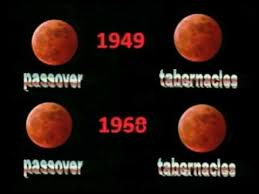
bloodmoons 3There has been some talk lately about blood moons—about four blood moons that are coming in the next two years: On April 15, 2014; on October 8, 2014; on April 4, 2015; and on Sept. 28, 2015.

What I am talking about is lunar eclipses. And it just happens that these four eclipses will happen on Jewish festivals—on Passover and on the Feast of Tabernacles.

bloodmoons 2In recent history when four blood moons occurred on Jewish festivals significant things happened. For example, when it happened in 1493 and 1494 Jews were expelled from Spain. The blood moons in 1949 and 1950 came right after the nation of Israel was assembled, giving the Jews a homeland for the first time in thousands of years (pictured on the left). And in 1967 and 1968 it was linked to the Six-Day War.

I am not an expert on this subject but I have found two men that are.  Click on these short videos if you want to be informed about this.

http://www.wnd.com/2013/10/blood-moons-expert-watch-2014-and-2015/

http://www.youtube.com/watch?v=vi78PmRX46Y

Posted in Understanding the Times | Tagged , , , , , , , | Leave a comment

Dreams: 4 ways to Purify Your Dreams

008

I think we all, from time to time, have dreams that aren’t too pure—myself included.  And it’s especially troublesome for Christians, because we are called to live pure lives (Matt 5:28; Eph. 5:3-4).  But the important thing is that we can do something about it; there are things that can be done to clean up impure dreams.

As you may know, dreams are mainly a product of what we think about during our awake hours. And this world we live in doesn’t help at all.  It seems as if our world is doing all it can to cause us to lust.  Books are written and movies are made with the very theme of lust and violence—because that’s what sells and what will bring a profit.  The best-selling books are probably the romance novels—and some are worse than others.  Young women are especially susceptible to these (or maybe I should say all women).  They may seem to be a harmless form of entertainment, but they are probably the most destructive, because they so easily bring the reader into a fantasy world; and then, eventually, fantasies become dreams.

Many people will say that there is really nothing we can do about lustful dreams—that we can’t control them, so we should not feel guilty over them.  But that’s not at all true.  The fact that you feel guilty is a good indication that your conscience is still in working order and it is telling you that something is amiss inside you and that you should do something about it.  And you can do something about it.  Here are…

Four Ways to Clean Up Your Dreams

1. Discontinue watching movies, TV shows, or reading anything that has lustful content.  This is the most important step, because what we feed our brain will be what we think about and what we eventually dream about.

2. Meditate on scripture, especially right before bedtime. Make a practice of this and you will find that your dreams will be sweet and clean!  Oh, also, meditate especially on verses that promote purity and having right thoughts toward God.  And it will help tremendously to memorize those verses so you have them with you always.  Psalm 119: 11 says, “Your word have I hidden in my heart, that I might not sin against You.”

3.  Before bedtime put on your spiritual armor, and have a battle plan ready.  Review what you will do and what verses you will quote in your dreams if you find yourself in sinful situations. And Count on God to be with you and help you.

4.  Pray at bed time that God would be near you and protect you from wrong dreams, that He will strengthen you, even in your dreams, to reject any lustful, sinful encounters.  And be encouraged that God will indeed help you in your dreams to fight against the enemy.


86660025

08320010

Posted in Bible Studies, Photography, Prayerful Thoughts and Intentions | Tagged , , , , , | 8 Comments

Four Stages of Abiding in God’s Word

006


In my study I have come up with four stages of abiding in God and His word.  These, I believe, are the stages that God takes us through when we abide in His word (when we seek to be connected to Him and draw nourishment from Him).  I hope they will encourage you.


Stage 1 – Read, study and meditate on the Word of God.  As you feed on the Word, listen to His voice and expect Him to speak to you.  If you have any problems concentrating on what you read, if you can’t seem to block out all the noises around you, try fasting.  Fasting will help to clean the body and soul from impurities.  It will draw you closer to God, help you to listen, and keep you more willing and eager to obey.


Stage 2 – Hear God’s voice and believe Him.  This stage obviously follows stage one because we don’t normally hear His voice until we read what He says to us in the Word; for the Bible tells us that “faith comes by hearing, and hearing by the Word of Christ” (Rom. 10:17).

But hearing and believing doesn’t always come to us automatically.  Sometimes we may think we hear and believe Him, but we really don’t.  We hear and believe only with our head, not our heart.  And so we are unknowingly trapped in stage one.  So how can we move on to stage two?  How can we be aided to hear and believe?

I suppose there are many things you can do, but what I would suggest is that you just stick with it; I mean just continue to study, pray and meditate more intently and with a greater desire to hear His voice—until you actually feel His presence.  This will be a sign to you that you have really heard His voice.  Andrew Murray
has said, “The presence of God Himself as the Promiser, not the knowledge of what He has promised awakens faith…” Therefore, when we hear Him with our heart then we will believe Him.


Stage 3 – Lovingly obey Him.  If we have truly believed His Word to us we will lovingly obey Him (I say lovingly because there is no other way to obey; for when we love Him we will obey Him, and when we obey Him we show that we love Him, Jn. 14:15).

This step is easy, in fact it is automatic, because, when we truly believe from the heart, God changes us and we will love and obey Him.  When Abraham believed God, God gave him the power to love and obey Him, even to sacrifice his own son Isaac (Heb. 11:17).  Also, when Noah believed God when God told him that He was going to destroy the earth with a flood, he too, in power, was compelled to obey God; and so in reverence he prepared the ark for his family and all the animals (Heb. 11:7).  Hence, in our quest to abide, it seems that this third stage of loving obedience is really a part of our faith.  In fact, when we examine chapter eleven of Hebrews (the faith chapter), we find all through the chapter that obedience was empowered by faith—thus by faith they obeyed God.


Stage 4 – Understanding and enjoying the union we have with the Father, the Son, and the Holy Spirit.  When we hear God’s words to us, and we obey Him in love, He rewards us by loving us and by disclosing Himself to us.  John 14:21 says, “He who has my commandments and keeps them, he it is who loves Me; and he who loves Me shall be loved by My Father, and I will love him, and will disclose Myself to him.”  Hence, we see that when we obey God’s Word, the Father and the Son together will love us.  But it is the person of Jesus who discloses Himself to us.  And I believe He does it by the operation of the indwelling Holy Spirit.

Therefore, in John 14:16-18 we see that the Father has given us the Holy Spirit as a helper to be with us forever.  He helps us by bringing the Father and the Son to us (Jn. 14:23); and He helps us to understand their love for each other, and their unity, and how we too are brought into this unity in Christ (Jn. 14:20).

Andrew Murray has written it this way: “Three times over He [Jesus] said, ‘If ye love me keep my commandments,’ promising a threefold blessing with which He would crown such obedient love: the indwelling of the Holy Spirit, the manifestation of the Son, the Father and Son coming to make Their abode with us.”

Murray then goes on to explain how we come to understand and receive the love and union of the Father and Son.  He says,

As our faith grows into obedience, and in obedience and love our whole being reaches out and clings to Christ, our inner life opens up.  The capacity is formed within us of receiving the life and the Spirit of the glorified Jesus, through a distinct and conscious union with Christ and with the Father.  The Word is fulfilled in us: ‘In that day ye shall know that I am in my Father and ye in me, and I in you’ (Jn. 14:20).  God and Christ exist in each other, not only in will and in love, but in identity of nature and life.  We come to understand that because of this union between the Father and the Son, so we are in Christ and Christ is in us in exactly the same way.

In this final stage of abiding, then, the Holy Spirit helps us understand and enjoy the presence, the unity, and the love of the Father, the Son, and the Holy Spirit.  And He also helps us to enter into that same wonderful unity.

 

Posted in Prayer A to Z Excerpts, Word and Prayer | Tagged , , , , , , , | Leave a comment