Four Reasons Why Speaking in Tongues Is Dangerous

Stephen Nielsen's avatarStudying Bible Prophecy

013

Tongues is at the heart of the Charismatic movement; it is one of their distinctives.  In this article I will point out its inaptness and its danger.

First of all, the biblical gift of tongues was an actual, known language—not ecstatic utterances, as we hear today (Acts 2:4, 11). Moreover, the purpose of tongues throughout the early church was a two-fold sign: 1) to the believers, that the Holy Spirit had come to begin the church; and 2) a sign of judgment to unbelieving Israel—that since they did not listen to God in a language they understood, He was now no longer speaking to them, but to the Gentiles in a language they could not understand (1 Cor. 14:21; Isa. 28:11-12); Thus God’s judgment was that He was no longer speaking to and dealing with them, but was now turning toward the Gentiles to establish His church.

Therefore, because…

View original post 379 more words

Posted in Reblogs | Leave a comment

10 Ways to Build Up Your Confidence in God

014


  1. Regularly repent and confess your sins. Let His blood make you clean so you can come to Him with confidence (1 Jn. 1:9).
  2. Welcome trials. Trials will build your character and holiness, which in effect will build your faith (Ja. 1:2-4).
  3. Obey Him regularly. When we fear God and obey Him in everything, the Bible says He will give us a strong confidence (Prov. 14:26-27).
  4. Meditate on the Word every day. Meditation will help you get to know God and His Word. It will help you to abide in Christ and to keep your mind on things above (Col. 3:1-2).
  5. Practice self-talk. This is part of what we do when we meditate. When you speak the Word of God back to yourself, those words will empower your faith.
  6. Fellowship with others. Don’t neglect to meet together with other Christians. This is God’s designed way to keep us encouraged (Heb. 10:24-25).
  7. Read about the heroes of faith in the Bible and from other Christian books. Imitate their confidence (Heb. 13:7) and let them be your heroes.
  8. Purpose to spend more time in prayer. Through prayer faith (confidence) is exercised and made more perfect.
  9. Constantly listen to God and cherish the desires He gives you. Pay attention to the Holy Spirit’s urgings. He will direct you in how to trust Him.
  10. Visualize what God wants to give you. If you have prayed about something and you are sure God wants you to receive it, then visualize it and believe that it is already yours (Mk. 11:24).


Posted in Part 3, Principles of Prayer, Prayer A to Z Excerpts, Zenith of Prayer | Tagged , , , | 2 Comments

Four Foundation Stones of Confidence in Prayer

the-good-shepherd-03

There are at least four elements we should consider as a basis for our confidence in prayer.


HIS BLOOD

We can be confident when we approach His throne because Christ our High Priest shed His blood for us and cleansed us inside and out; hence, on the basis of His blood we may come to Him courageously (or boldly), without fear, and with assurance that He will hear us and lovingly give us what we need.


HIS WORD

A second basis for confidence is God’s Word. Through His Word we can know His will, and therefore, we are able to pray more directly and specifically, according to His will.


HIS CHARACTER

Thirdly, confidence is based on God’s character. Even if we had no definite promise from His Word, if we have some knowledge of His past mercies, and if we have grown to know His goodness, than we have a strong foundation for confidence in Him.


HIS SPIRIT

A forth foundation stone for confidence in prayer is God’s Spirit. We cannot have confidence in prayer without His Spirit; for it is the Sprit that urges us to believe and trust in Him. If we have The Holy Spirit we have every reason to be confident.

Posted in Part 3, Principles of Prayer, Prayer A to Z Excerpts, Zenith of Prayer | Tagged , , , , , , | Leave a comment

Why do we need to pray with confidence?

029 pro Bk - Copy

Why do we need to pray with confidence? God knows we are human. Why can’t we just pray the way we want? This is an important question. I suppose we could pray any way we want, but where would it get us? Certainly, if you insist on not following the Biblical way to pray—with confidence—your prayers will be useless, empty, like the prayers of the hypocrite and the pagan (Matt. 6:5-8). God does not honor prayers that are not of faith (Heb. 11:6). If we expect God to answer our prayers we must have confidence in Him. It won’t work any other way. The Psalmist says in Psalms 115:3, “Our God is in heaven; He does whatever pleases him” (NIV). In other words, He is in charge and He makes the rules. We must not argue with Him or disagree with Him. In fact, if we want to have any joy in this life, we must try to obey Him in everything, including how we pray; for He has designed everything the way it should be, for our good and for His glory.

Posted in Part 3, Prayer A to Z Excerpts, Principles of Prayer, Zenith of Prayer | Tagged , , , , , , | 1 Comment

Jesus’ Last Prayers were Simple, Direct and Earnest

agony-in-the-garden

 Just after Jesus’ prayer, in John 17, He and His disciples went out to the Mount of Olives. And when they came to a place named Gethsemane (The Garden of Gethsemane), He told His disciples to sit and wait for Him; and He took Peter, James and John to another place nearby to pray.


Matthew 26:39, 42 (also Mark 14:36; Luke 22:42)

He went a little farther and fell on His face, and prayed, saying, “O My Father, if it is possible, let this cup pass from Me; nevertheless, not as I will, but as You will.”… 42 Again, a second time, He went away and prayed, saying, “O My Father, if this cup cannot pass away from Me unless I drink it, Your will be done.”


When they arrived at the place, He felt so deeply distressed that He told the three to sit and wait and pray while He went just a little further to pray alone. Evidently, at this particular time, He required absolute privacy with His Father.

His prayer was simple and direct, revealing exactly what He thought and felt.   His feelings told Him that He didn’t want to do it; He didn’t want to be crucified. So He said to His Father, “If it is possible, let this cup pass from Me.” But He knew His Father’s will and what He must do; so He also prayed, “Nevertheless, not as I will, but as You will.”

This prayer is an excellent example of how Jesus prayed. He didn’t carefully form His words in order to make a good and righteous prayer, that is, a prayer that would impress those that would hear Him. He prayed simply what He happened to be thinking and feeling. In this case, He was thinking that He really didn’t want to be crucified because it was going to be painful and horrible—suffering for all the sins of the world.   But at the same time He also knew He had to do it—for the sake of God’s will, and for the love of God and mankind.

Jesus prayed basically the same prayer three different times, giving Himself a break between those times of prayer to go back and check on His three comrades. And each time He came back to them, He found them sleeping.

Now, as it happened, during His prayer, probably during the last time he prayed, an angel came to Him and strengthened Him (Luke’s gospel alone records this). And then the very next thing that happened (Lu. 22:44) was that He prayed more earnestly though being in great agony. Therefore, it seems clear that the reason the angel came was to strengthen Him to pray even harder—with more fervency. Here is proof that God wants us to pray and keep praying. And if the situation requires that prayers be more earnest, then He will give us the strength to do it, even if He has to send an angel to help us.


Posted in Part 5, Ezra to John, Prayer A to Z Excerpts, Survey of Prayer | Tagged , , , | Leave a comment

Approach Problems with Prayer and Patience

Stephen Nielsen's avatarStudying Bible Prophecy

86660012


Recently, when faced with

Troubles insurmountable

Temptations there were

To be hasty, rash,

Impatient and rude


God, however,

Beckoned me forward

With prayer and patience

And I knew it was right


Oh praise Him!

The next day with joy

Each problem found

An answer!


Now what can I say

Though problems overwhelm,

Sorrows abound,

And solutions appear distant,

Approach each problem

With prayer and Patience

Expecting God to answer


1 Peter 4:7

The end of all things is at hand; therefore, be of sound judgment and sober spirit for the purpose of prayer.


Philippians 4:6-7

Be anxious for nothing, but in everything by prayer and supplication with thanksgiving let your requests be made known to God. 7 And the peace of God, which surpasses all comprehension, shall guard your hearts and your minds in Christ Jesus.


Hebrews 4:16

Let us therefore draw near…

View original post 22 more words

Posted in Prayerful Thoughts and Intentions, Reblogs | Tagged , | Leave a comment

Don’t Let Troubles Hinder the Joy

Stephen Nielsen's avatarStudying Bible Prophecy

010 great

Don’t let the

Troubles of life

Hinder the joy

That God has

Already begun

In you

In fact, embrace

Your troubles

And pray over

Each of them

Knowing that

They will

Produce in you a

More complete

Joy

References

James 1:2-3Consider it all joy, my brethren, when you encounter various trials, 3 knowing that the testing of your faith produces endurance.

Nehemiah 8:10 — Then he said to them, “Go, eat of the fat, drink of the sweet, and send portions to him who has nothing prepared; for this day is holy to our Lord. Do not be grieved, for the joy of the Lord is your strength.”

Galatians 5:22But the fruit of the Spirit is love, joy, peace, patience, kindness, goodness, faithfulness, 23 gentleness, self-control; against such things there is no law.

1 Thessalonians 5:16-18Be joyful always; 17 pray…

View original post 17 more words

Posted in Bible Studies, Prayerful Thoughts and Intentions, Reblogs | Tagged , , | 2 Comments

Confidence in Prayer — Four Possible Meanings

013


What is confidence? And what do we mean by praying with confidence? I think there are at least four possible meanings. Basically, confidence means to have faith, to trust, to believe, or to rely on. Confidence in prayer means that when I pray I believe or trust in God and in His Son Jesus Christ. It also means that I believe in the promises of His Word.

Secondly, confidence means that I have hope and that I have assurance. In prayer it means that I can pray without doubting because I have hope in His word and I have assurance that He will not go back on His promises. In Philippians 1:3-6 we have a good example of a prayer with confidence. Here Paul writes, “I thank my God upon every remembrance of you… being confident of this very thing, that He who has begun a good work in you will complete it until the day of Jesus Christ.”

A third variation of the meaning of confidence is courage, also to feel safe. These may be two different meanings, but I think they go together; for when God gives me courage, I also feel safe and secure. When we approach God’s throne in prayer we can and should approach His throne with this kind of confidence—a confidence that is courageous, that feels no fear (Heb. 4:16).

Last, confidence means to take hold of something. In prayer it means that when I pray I take hold of His promise. Hence, when I pray with confidence concerning a request that I believe God will give me, I take hold of it with strong faith and I visualize that it is already mine. The teaching for this kind of confidence in prayer is in Mark 11:20-24. Here Jesus teaches, “Have faith [confidence] in God… Therefore I say to you, whatever things you ask when you pray, believe that you receive them, and you will have them.”

Posted in Part 3, Principles of Prayer, Prayer A to Z Excerpts, Zenith of Prayer | Tagged , , , , , , , | Leave a comment

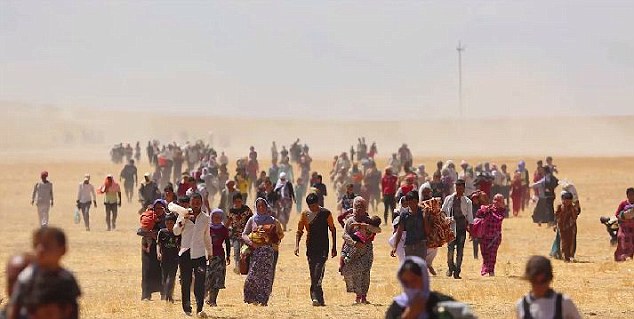
Mideast Persecuted Christians Not Allowed to enter U. S.

Stephen Nielsen's avatarStudying Bible Prophecy

1415130861170_wps_10_prince_charles_church_aid

Did you know that there is an Obama administration policy in place now that will not allow fleeing, persecuted Christians into the United States, but they will allow in Muslims? Why is that? What has happened to America? Watch this video.

Key points of video:

  • Conditions for Christians in Iraq are terrible
  • Iraqi Christians have been forced out of their home by ISIS
  • They have no place to go; they are starting to beg for food
  • They either have to live in refugee camps in Jordan or find their own way out
  • They are awaiting for ISIS to be defeated
  • Many would like to go to the United States but the United States is not allowing them to enter
  • Overall, the U. S. has so far allowed 80% of Muslims to come to the United States, but only 6% of Christians

help Iraq

View original post

Posted in Reblogs | 1 Comment

Jesus’ Masterful Prayer (in John 17): 4 Things We Can Learn From It

the-good-shepherd-03


Here is a masterful prayer. There is no doubt that we could learn much from it. But I want to focus on just four things: that the requests are specific and definite; that His prayers are purposeful; that they are reflective; and that, over all, they are conversational.

Jesus’ prayers were always specific and definite. He had no time for generalities and vagueness.   In two places in this prayer, where Jesus thought that there might be some perceived vagueness, He took the time to explain exactly how He meant to pray. In verse nine, when He said, “I pray for them,” He went on to explain in His prayer who “them” was. He said, “I pray not for the world, but for those whom You have given Me.” Then in verse fifteen He makes definite another part of His prayer that could be confusing; when praying for His disciple’s safety, He prays, “I do not pray that You should keep them out of the world, but that You should keep them from the evil one.”

Jesus’ prayers were purposeful. Everything He prayed for had a correct motive or purpose. In this prayer, when He prayed for His own glory—“Father, the hour has come. Glorify Your Son…”—the motive ultimately was so that His Father would be glorified; for He prayed, “…that Your Son also may glorify You.” It follows, therefore, that if He was honored in His death by giving eternal life to as many as the Father gave Him (v. 2), that would honor the Father.

Likewise, when Jesus prayed, “Keep them [His disciples] in thy name,” the reason was so that they would eventually be one, as He and the Father were one (vv. 11-12).

Also, when He prayed (in verse 24), that “they [all believers] may be with Me where I am,” the reason here was so that they (we) would behold His glory. And I believe “behold” means more than just to see and observe. I think it means to participate in and enjoy. Yes, the reason He wants us to be with Him, and the reason He prayed for us to be with Him, was so that we can see and also participate in and enjoy His glory and honor.

His prayers here are also reflective; that is, they are dependent on certain works that have been done. Hence, throughout this prayer He makes mention of His and His Father’s work. Here are a few clippings from the prayer: “You have given Him [the Son] authority over all flesh” (v. 2); “I have glorified You on the earth; I have finished the work which You have given Me to do” (v. 4); “I have manifested Your name to the men whom You have given Me out of the world” (v. 6); “I have given to them the words which You have given Me” (v. 8). And so it goes throughout the prayer.

The mention of these works is so important because it forms a basis for what He is praying, and it gives Him a reason why He can expect to receive an answer. For example, in verse four, when He said, “I have finished the work which You have given Me to do,” that work was the basis for which He could pray, “And now, O Father, glorify Me together with Yourself…”

Accordingly, in our prayers, we must also mention the works of Jesus and the Father and the Holy Spirit, and how we have done works in Jesus name—so that our prayers become valid, with a sound foundation. For if there are not past works, we can’t really pray with any claims, hence, with any hope or confidence. Therefore, at the mention of past works in our prayers, especially the works of God, we bring power, hence, confidence and faith to our prayers.

Lastly, this prayer (and all of Jesus’ prayers) was conversational. He not only made requests to His Father, but He made conversation. He prayed as one would talk to another—to a friend. Therefore, in between His requests were statements of fact made to flesh out a conversation, such as, “Father, the hour has come” (v. 1), and, “and this is eternal life, that they may know you, the only true God” (v. 3). And so it seems that whatever He was thinking He prayed in words. Let that be your style of prayer also, for God wants to hear what you’re thinking, not just a list of what you want.


John 17

These things Jesus spoke; and lifting up His eyes to heaven, He said, “Father, the hour has come; glorify Thy Son, that the Son may glorify Thee, 2 even as Thou gavest Him authority over all mankind, that to all whom Thou hast given Him, He may give eternal life. 3 “And this is eternal life, that they may know Thee, the only true God, and Jesus Christ whom Thou hast sent. 4 “I glorified Thee on the earth, having accomplished the work which Thou hast given Me to do. 5 “And now, glorify Thou Me together with Thyself, Father, with the glory which I had with Thee before the world was. 6 “I manifested Thy name to the men whom Thou gavest Me out of the world; Thine they were, and Thou gavest them to Me, and they have kept Thy word. 7 “Now they have come to know that everything Thou hast given Me is from Thee; 8 for the words which Thou gavest Me I have given to them; and they received them, and truly understood that I came forth from Thee, and they believed that Thou didst send Me. 9 “I ask on their behalf; I do not ask on behalf of the world, but of those whom Thou hast given Me; for they are Thine; 10 and all things that are Mine are Thine, and Thine are Mine; and I have been glorified in them. 11 “And I am no more in the world; and yet they themselves are in the world, and I come to Thee. Holy Father, keep them in Thy name, the name which Thou hast given Me, that they may be one, even as We are. 12 “While I was with them, I was keeping them in Thy name which Thou hast given Me; and I guarded them, and not one of them perished but the son of perdition, that the Scripture might be fulfilled. 13 “But now I come to Thee; and these things I speak in the world, that they may have My joy made full in themselves. 14 “I have given them Thy word; and the world has hated them, because they are not of the world, even as I am not of the world. 15 “I do not ask Thee to take them out of the world, but to keep them from the evil one. 16 “They are not of the world, even as I am not of the world. 17 “Sanctify them in the truth; Thy word is truth. 18 “As Thou didst send Me into the world, I also have sent them into the world. 19 “And for their sakes I sanctify Myself, that they themselves also may be sanctified in truth. 20 “I do not ask in behalf of these alone, but for those also who believe in Me through their word; 21 that they may all be one; even as Thou, Father, art in Me, and I in Thee, that they also may be in Us; that the world may believe that Thou didst send Me. 22 “And the glory which Thou hast given Me I have given to them; that they may be one, just as We are one; 23 I in them, and Thou in Me, that they may be perfected in unity, that the world may know that Thou didst send Me, and didst love them, even as Thou didst love Me. 24 “Father, I desire that they also, whom Thou hast given Me, be with Me where I am, in order that they may behold My glory, which Thou hast given Me; for Thou didst love Me before the foundation of the world. 25 “O righteous Father, although the world has not known Thee, yet I have known Thee; and these have known that Thou didst send Me; 26 and I have made Thy name known to them, and will make it known; that the love wherewith Thou didst love Me may be in them, and I in them. “



Posted in Part 5, Ezra to John, Prayer A to Z Excerpts, Survey of Prayer | Tagged , , , , , , | 3 Comments